
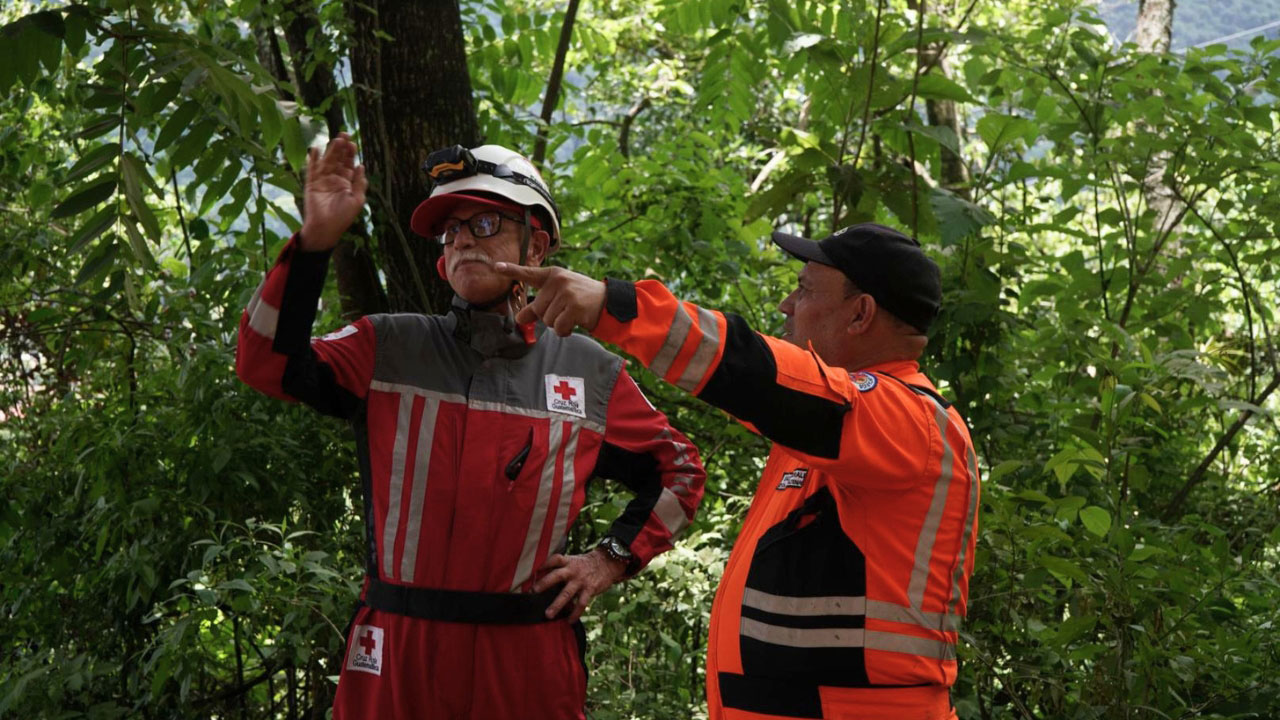
Panama City, May 19, 2026. With an urgent call to move beyond reactive logic and embrace preparedness as a permanent policy and practice, the 23rd Pre-Hurricane and Recurrent Hazards Conference opened this Tuesday.
The opening ceremony brought together Fanny Moreira, Technical Secretary of the Andean Committee for Disaster Prevention and Relief (CAPRADE), Elizabeth Rilley, Executive Director of the Caribbean Disaster Emergency Management Agency (CDEMA), Alejandro Picado, Pro Tempore President of the Coordination Center for Disaster Prevention in Central America and the Dominican Republic (CEPREDENAC), Andrea Koulaimah, Director for Latin America and the Caribbean, Sub-Saharan Africa, Asia and the Pacific of the European Civil Protection and Humanitarian Aid Operations Directorate-General (ECHO), Shelley Cheatham, Head of the Regional Office for Latin America and the Caribbean of the United Nations Office for the Coordination of Humanitarian Affairs (OCHA), and Loyce Pace, Director for the Americas of the International Federation of Red Cross and Red Crescent Societies (IFRC).
Communities as the starting point
Loyce Pace opened by evoking an image: a woman from a coastal village who wakes before dawn, with four young children, in a neighborhood still recovering from previous flooding and a dengue outbreak. When her phone sends a river flood alert, she knows what to do. She has a go-bag ready, knows the meeting point, and took part in the drill organized by the local Red Cross volunteer. “That woman still doesn’t know if the river will overflow. But she is ready,” said Pace. “That image is the reason we are here today.”
With that framing, the IFRC’s regional director captured the purpose of the conference: if coordination and anticipation improve, more people will be safe — not as a result of chance or the circumstantial generosity of whoever happens to be available that year, but thanks to systems built in advance.
A more complex and less predictable environment
All speakers described a landscape in which risks accumulate and overlap. Hurricanes make landfall in communities that months earlier were already suffering droughts that destroyed their harvests; wildfires worsen respiratory illness in areas where health systems never recovered from the pandemic; families fleeing violence settle in marginalized zones where infrastructure collapses every rainy season. Crises no longer arrive in isolation: they pile on top of one another, leaving people with less time to recover and fewer resources to withstand each new blow.
Shelley Cheatham stressed that today’s operational environment is substantially different from what it was just two years ago: more simultaneous threats, organizations working with fewer resources and fewer options. “We cannot assume that everything that was there before is still there,” she said, emphasizing that moments like this conference are essential for actors to know one another, build trust, and be able to act in a coordinated way when emergencies arrive.
Risks do not respect borders
Fanny Moreira recalled that although hurricanes do not directly affect Bolivia, Colombia, Ecuador and Peru, their effects do reach the region — through disrupted supply chains, population movements, and cross-border humanitarian needs. “Risk does not recognize administrative borders,” she said, calling for disaster management with a regional, solidarity-based, and coordinated outlook.
Alejandro Picado echoed this from a Central American perspective: Central America and the Dominican Republic have learned, season after season, that no country can respond alone to increasingly complex scenarios. Through CEPREDENAC, he noted, the region has worked to strengthen regional coordination mechanisms with a vision that goes beyond response and integrates preparedness, technical articulation, and resilience-building.
Preparedness as investment, not expenditure
Andrea Koulaimah cited the response to Hurricane Melissa as a tangible example of what advance investment produces: early warning systems worked, damage mapping was activated immediately, and the response was effective precisely because preparedness had come first. As a result of those lessons, ECHO decided to expand the prepositioned stocks in Panama within the comprehensive disaster management program.
Pace reinforced this logic with stark data: by 2030, 560 disasters per year are projected worldwide — one and a half every single day — while humanitarian funding continues to shrink. In 2025, humanitarian needs in Latin America and the Caribbean alone reached 3.6 billion dollars, and available resources fall far short of that figure. She also flagged indirect pressures: the escalation of global conflicts has driven up operational costs, directly affecting prepositioned supply capacity and logistics. “Every dollar invested in risk reduction generates four dollars in benefits,” she said. “We know this. But knowing it is not enough.”
The infrastructure that sustains the response
The opening session also highlighted the auxiliary role of National Red Cross Societies as a key element in coordination among states, communities, and the broader humanitarian ecosystem. This role — a unique legal and technical status held by National Societies — is critical for saving lives, and is strengthened through cooperation agreements such as those signed by the IFRC with CEPREDENAC, the European Union, CDEMA, and UNDRR.
Also identified as a key life-saving instrument is the international treaty on the protection of persons in disaster situations, currently under consultation at the United Nations, which seeks to enshrine in binding law what is already known to work: faster assistance, with fewer obstacles and greater dignity, especially for those facing the greatest vulnerability.
Over the next three days, some 1,500 participants will examine mechanisms, protocols, and working approaches aimed at strengthening preparedness and coordination in the face of disaster. The agenda spans a wide range of areas: from forecasting and early action to the use of artificial intelligence and technology in humanitarian response, as well as protection, gender and inclusion, and investment in early warning systems.